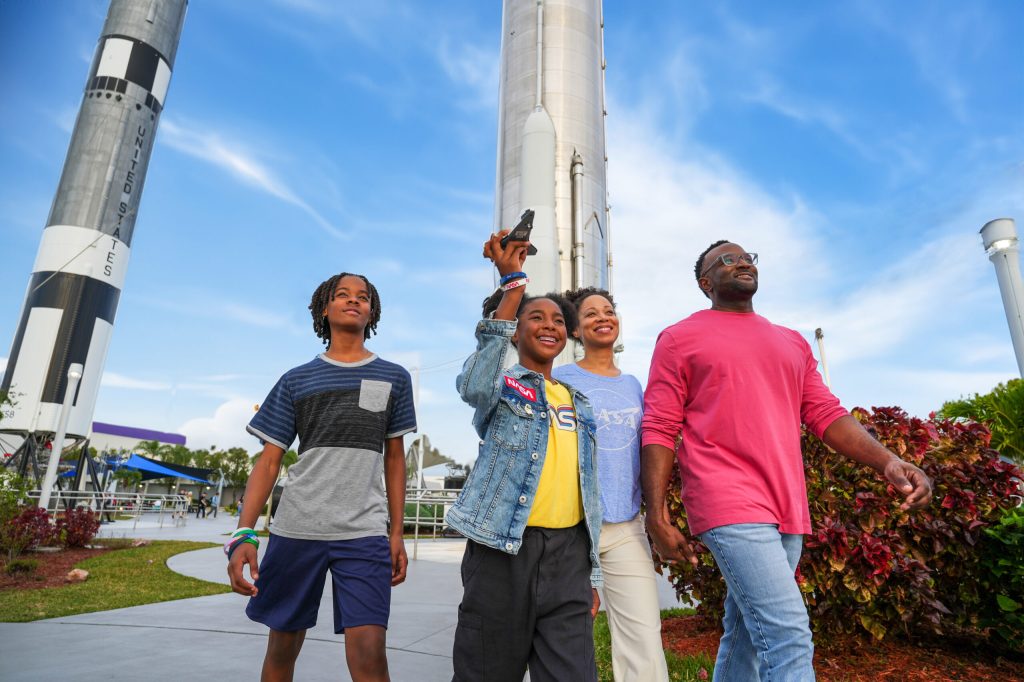
From rocket launches to lunar dreams, a visit to Kennedy Space Center Visitor Complex is turning cosmic curiosity into the ultimate travel experience
By Donna Richardson
There is a particular kind of silence that settles over Florida’s Space Coast just before a rocket launch – a pause so complete that even the seabirds circling above the Atlantic seem to hover mid-air. Then comes the ignition: a low rumble that builds into a thunderous roar, rippling across marshland and mangrove, vibrating through the ground beneath your feet. It is less a sound than a physical sensation – and once you’ve felt it, you never quite forget it.
In 2026, that feeling is back at the centre of the travel conversation. The world has once again become fascinated with the Moon, thanks to the recent mission from NASA and its ambitious Artemis programme – humanity’s long-awaited return to deep space exploration. For travellers, the excitement has sparked a new kind of pilgrimage, drawing visitors to Florida’s east coast not just for sunshine and theme parks, but for a glimpse of the future.
And nowhere captures that spirit more vividly than the Kennedy Space Center.
Located on Merritt Island, about an hour’s drive from the rollercoasters of Orlando, the complex feels worlds away from the neon-lit buzz of Central Florida. Here, the landscape is quieter, wilder – a sweep of wetlands and lagoons where alligators glide through still water and ospreys nest on weathered launch structures. It is a place where technology and nature sit side by side, and where the horizon seems permanently tilted toward the sky.
For many visitors, the first encounter is unforgettable. Inside the vast hangar housing the Space Shuttle Atlantis, the shuttle appears suspended in mid-flight — doors open, robotic arm extended – as if it has just drifted in from orbit. Children fall silent. Adults crane their necks. Even seasoned travellers find themselves lingering longer than expected, drawn in by the scale of human ambition.
Yet the most powerful moment often comes later, at the Apollo/Saturn V Center. Step inside, and you are suddenly face-to-face with the Saturn V rocket — the colossal machine that carried astronauts to the Moon. Stretching longer than a football pitch and towering overhead like a cathedral ceiling, it has an almost spiritual presence. Visitors instinctively lower their voices. Photographs never quite capture its magnitude; it has to be felt in person.
But the appeal of the Kennedy Space Center today is not nostalgia. It is momentum.
Behind restricted gates, the complex remains a working spaceport, and the sense of anticipation is constant. On the famous bus tour, visitors travel past the cavernous Vehicle Assembly Building – one of the largest structures on Earth by volume — and along the historic launch pads that have sent generations of astronauts skyward. These are not relics. They are active launch sites, poised for the next chapter in human exploration.
New attractions are designed to bring that future into sharper focus. At The Gantry at LC-39, a reimagined observation tower unveiled in 2025, visitors climb to panoramic viewing decks overlooking the launch pads and shimmering wetlands beyond. Inside, interactive exhibits explore how satellite technology is helping scientists track climate change, predict storms and monitor the health of the planet — a reminder that space exploration is not only about distant worlds, but about understanding our own.
Elsewhere, Gateway: The Deep Space Launch Complex feels like stepping into tomorrow. Sleek spacecraft prototypes gleam under theatrical lighting, robotic explorers roam simulated landscapes, and immersive motion-theatre journeys whisk guests to destinations such as Mars or Saturn. It is part museum, part theme park, part vision of what commercial space travel might one day become.
Evenings on the Space Coast have their own rhythm. As the sun sinks into the Atlantic, the sky shifts from coral pink to indigo, and conversation in waterfront restaurants turns inevitably toward launch schedules and mission updates. Locals speak about rockets the way surfers talk about waves — with a mixture of reverence and anticipation. When a launch window approaches, hotel balconies fill with spectators, cameras poised, eyes fixed on the horizon.
And then, if timing and weather align, comes the moment every visitor hopes for: a live launch.
From viewing areas just a few miles away, the countdown echoes across loudspeakers. Ten. Nine. Eight. A column of fire erupts beneath the rocket, illuminating the coastline in brilliant white light. The ground trembles, the air crackles, and within seconds the spacecraft arcs gracefully into the sky, shrinking to a bright star before disappearing into the darkness.
It is theatre, science and raw emotion combined — a reminder that exploration is not only a technological achievement, but a profoundly human one.
For travellers planning a Florida itinerary, a day at the Kennedy Space Center offers a striking counterpoint to the region’s more familiar attractions. It is educational without feeling earnest, thrilling without relying on fantasy, and unexpectedly moving in ways few destinations manage.
After all, standing beneath a rocket bound for space has a way of reshaping perspective.
You leave with sand on your shoes, the echo of engines in your chest, and a quiet, lingering thought: the future is being built here – and you were close enough to feel it.
 LUXE Serendipity magazine
Leave a comment