By Donna Richardson
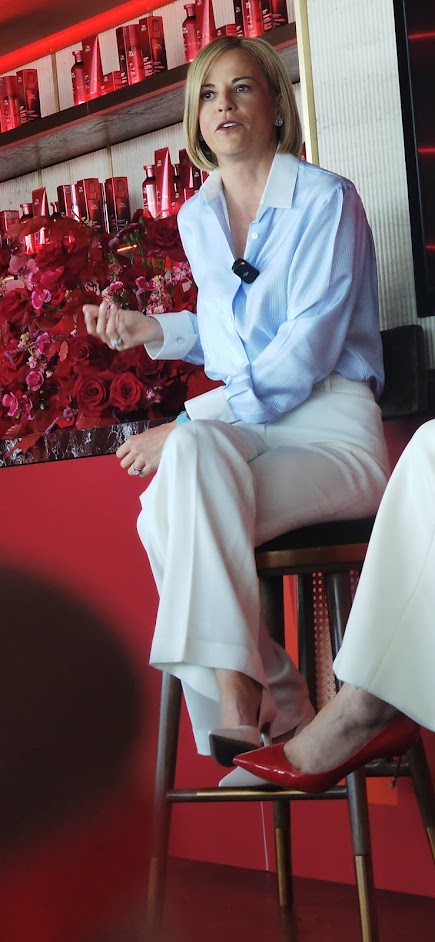
There are moments during Formula One race week when the conversation shifts away from lap times and podium predictions towards something altogether more enduring. High above London, as the countdown to the British Grand Prix gathered pace, one such moment unfolded at an intimate lunch hosted by Wella Professionals in partnership with F1 Academy. The focus was not on who would win on Sunday, but on who would have the opportunity to compete tomorrow.
Held at CÉ LA VI, the event brought together an influential group of women from sport, business, media and fashion for an afternoon centred on female leadership, confidence and opportunity. The setting reflected the occasion. Red roses, chosen to mirror Wella Professionals’ signature branding, framed the venue, while floor-to-ceiling windows overlooking the capital were adorned with the campaign slogan “Make It You.” Every table was meticulously laid for VIP guests, each place setting accompanied by a gift bag filled with Wella’s professional haircare products. Many of those in attendance arrived sporting immaculate blow-dries – sleek, glossy and perfectly styled-showcasing the craftsmanship of one of the world’s leading professional hair brands.
Yet despite the polished surroundings, the conversation quickly moved beyond beauty and branding. At its centre sat Susie Wolff, former racing driver, one of the few women to participate in an official Formula One race weekend, and now Managing Director of F1 Academy, whose mission is to create a sustainable pathway for the next generation of female racing drivers.
What gives Wolff’s perspective such authority is that it is rooted not in observation but in experience. Before taking on one of the most influential leadership positions in modern motorsport, she forged her own career through karting, Formula Renault, Formula Three and the German Touring Car Championship, and joined Williams Racing as a development driver. In 2014, she became the first woman in more than two decades to drive during an official Formula One Grand Prix weekend – an achievement that highlighted both her own ability and the absence of women at the highest level of the sport.
Looking back on that journey while writing her memoir, Driven, she admitted it was not the victories that ultimately defined her.
“When I looked back over my life while writing my memoir, those failures and setbacks shaped me even more than the successes.”
It is a sentiment that underpins much of her leadership today. There is little appetite for celebrating individual milestones if the structures surrounding them remain unchanged.
Reflecting on her early career, Wolff spoke candidly about what it meant to pursue a dream in an environment where female role models scarcely existed. Going back to my journey, it was passion. At the time, we never saw a woman in this male-dominated environment, so tenacity for what I was doing empowered me and helped me get where I am today.”
That resilience, however, should not become a prerequisite for future generations.
Her diagnosis of the problem was refreshingly simple.
“Talent exists everywhere, but opportunity does not.”
It is perhaps the clearest explanation of why F1 Academy exists. Rather than serving as a symbolic championship, it has been designed to create genuine pathways through investment, visibility, sponsorship and long-term development, ensuring talented young women have somewhere to progress as their careers advance.
Accepting the role was not, she admitted, an automatic decision.
“The tenacity of who I am now, and what I have become, when I got the call from the head of F1 to head up the Academy, I felt I had done all the diversity panels. I spoke about my journey, and then I realised, in those discussions, they were really serious about making it impactful. I realised this was a once-in-a-lifetime chance for us to not just have an impact on the sport but create incredible opportunities for the next generation.”
It marked a transition from being someone who repeatedly spoke about barriers to someone now capable of dismantling them.
Today, Wolff occupies a position that previous generations of women in motorsport simply did not have, and she is acutely aware of the responsibility that comes with it.
“Now I am in a position of power. If I can help open a door for others and make an impact on a sport which just keeps getting bigger and bigger…”
The remark encapsulated the philosophy that ran throughout the afternoon. Leadership is no longer measured solely by personal success, but by how many others benefit from it.
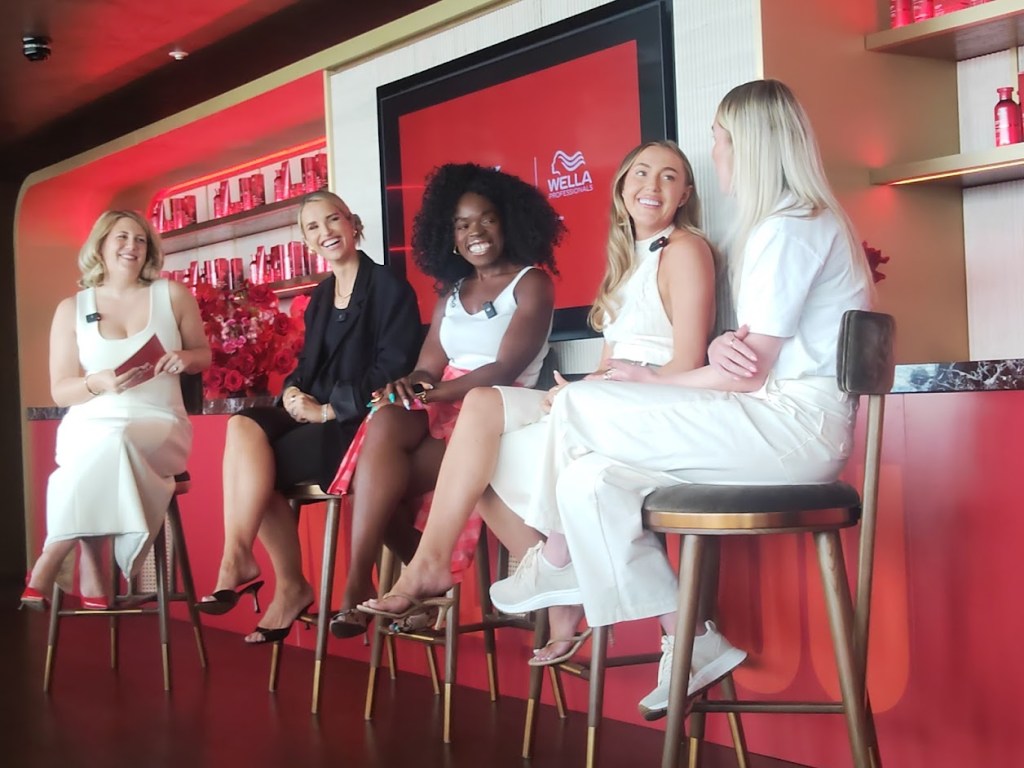
As discussions broadened to include broadcaster and entrepreneur Vogue Williams, fashion entrepreneur Aimee Smale, footballer Missy Bo Kearns and skeleton racer Tabby Stoeker, the conversation moved fluidly between elite performance, entrepreneurship and representation. Different industries, different experiences, yet remarkably similar conclusions.
Reflecting on her own journey, Missy Bo Kearns said:
“When I was younger, I used to have my hair in a low ponytail and wear my football kit- I was one of the boys,” she said.
Seeing the opportunities women in motorsport need. It’s what got me playing in the Premier League around top people. Everyone can do what they want – you have to put your mind to it. Now women’s football is better than men’s football.”
Aimee Smale spoke about building her fashion business through authenticity and community rather than a large marketing budget.
“I wanted to start a brand. I had no marketing budget – I just had my phone, and I was sharing with other women what I was doing. That’s how I quickly gained an audience. I quit my job and began selling clothes, but so many people were behind me. Social media is a positive place to share what you’re doing, and that has always kept me going. It is incredibly hard, but community is so important.”
Fashion editor Nana reflected on the importance of staying true to herself.
“Always showing up -I can’t be anyone but myself. It’s good to know I’m not putting on any airs and graces. Whether it’s me loving being the most overdressed person in the room, I take pride in that, and people really resonate with it. I get so many lovely messages. I’m also really into my fitness and ran the London Marathon this year. When you show up online, people resonate with those things and see themselves in you.”
“Women can be feminine and fierce.”
Victoria, who led the panel. emphasised the importance of having strong women around you, while Vogue Williams reflected on the influence of her own family. “It’s important to have women in your corner and fighting for you.”
Vogue agreed: “I love hanging out with girls -my mum and my sisters. My mum was the first person I hung out with. She broke up with my dad and had five jobs. She was so strong, and I was a tomboy. Having strong women in your life is so important. My husband also really supports me in what I want to do.”
Discussing the challenges faced by working mothers, Vogue continued:
“There has to be more support for working mothers. Women can have it all – you can do both. I would never give up my job because I love what I do, and achieving a goal is just as important as being with my kids.”
Leadership, the panel suggested, is no longer confined to traditional ideas of authority. It can be collaborative as well as competitive, empathetic as well as ambitious.
Wolff challenged another long-held assumption -that women must somehow sacrifice their identity to lead.
“Women can be feminine and fierce.”
It was a deceptively simple statement, yet one that rejected decades of outdated thinking within elite sport and business alike.
Equally powerful was her belief that progress should never be viewed as a competition between groups.
“When the tide rises, we all rise.”
Wolff also credited both her mother and her husband, Toto, with helping shape her career and confidence.
“My husband fought in my corner and lifts me up. He is also Austrian, so he is very direct and doesn’t shy away from tough love, so he shaped me. When I had just become a mother, he supported me in going for it and keeping my dreams alive. If someone is giving you energy or taking it away, it’s an indication of whether you pick your phone up immediately or not.”
Rather than framing equality as a redistribution of opportunity, she argued that removing barriers ultimately strengthens the sport as a whole by widening its talent pool and enriching its future.
The afternoon itself unfolded with subtle nods to motorsport. The dining experience was served in “laps”, with each course arriving as another stage of the journey. Lap One featured edamame beans dusted with tom yum salt. Lap Two included duck bao buns, shrimp tempura, beef skewers, heritage tomato and watermelon. Lap Three brought grilled salmon, satay chicken breast, summer toban yaki vegetables and grilled tenderstem broccoli before the Final Lap concluded with tapioca mousse alongside a selection of ice cream and sorbet.
Between courses, conversation flowed as naturally as the service. Journalists exchanged views with Olympic hopefuls, entrepreneurs discussed leadership with athletes, and conversations ranged from elite training schedules and winning gold medals to confidence, imposter syndrome and the challenges women continue to face within male-dominated industries. Speaking with skeleton racer Tabby Stoeker, the discussion turned to the extraordinary discipline required to compete at the highest level, illustrating that, whether on ice or asphalt, resilience remains a universal currency.
“We train all year round,” she revealed.
Throughout the afternoon, there was a palpable sense that women’s sport has entered a different era. Record audiences, increased commercial investment and growing corporate partnerships have transformed the landscape in recent years, yet Wolff was careful not to present the moment as one of completion.
“This is such an exciting chapter for the F1 Academy.”
It was both a celebration and a reminder that the work is far from finished.
The distinction may seem subtle, but it is significant. For decades, women were invited into spaces built by others. Today, figures like Susie Wolff are helping redesign those spaces entirely.
That, perhaps, is the real story of women’s sport in 2026. It is no longer necessary to ask for permission to participate. It is shaping the future of the industries it inhabits, proving that leadership is not about fitting into the existing mould but about having the courage – and increasingly, the influence- to create a better one.
As British Grand Prix week continued and attention inevitably returned to the racing itself, the most meaningful conversation may well have been the one taking place away from the circuit. Because the future of motorsport will not be determined solely by who crosses the finish line first, but by who is allowed to stand on the grid in the first place.


Leave a Reply