Sometimes healing doesn’t begin with having all the answers. Sometimes it begins with finally stopping long enough to listen to yourself, Donna Richardson discovers.
There are journeys we take because we want to see somewhere new, journeys we take because we want an adventure, and then there are thosse we take because something inside us has quietly reached the point where it is asking for change. By the time I arrived in Innsbruck, I knew I was taking the third kind of journey. I had not come to Austria simply to escape for a week or to enjoy the beauty of the Alps, although the beauty of the landscape would become an important part of my experience. I had come because, after six months of mental anguish, stress, uncertainty and growing concern about my health, I felt exhausted by my own life.
My digestion felt sluggish, my IBS had become difficult to manage, my energy had almost disappeared and I had become increasingly preoccupied with what the symptoms I was experiencing might mean. There were hormonal concerns too, alongside emotional wounds and difficult experiences from childhood that I had carried for years without properly addressing them. I felt as though my body, which had once felt familiar and dependable, had somehow become something I no longer understood. I wanted answers, of course. I wanted reassurance. I wanted someone to tell me what was happening and what I could do about it. But underneath that desire for certainty was another, quieter need. I wanted a reset. I wanted to get away from the constant cycle of worrying, researching, questioning and trying to work everything out. More than anything, I wanted to stop.
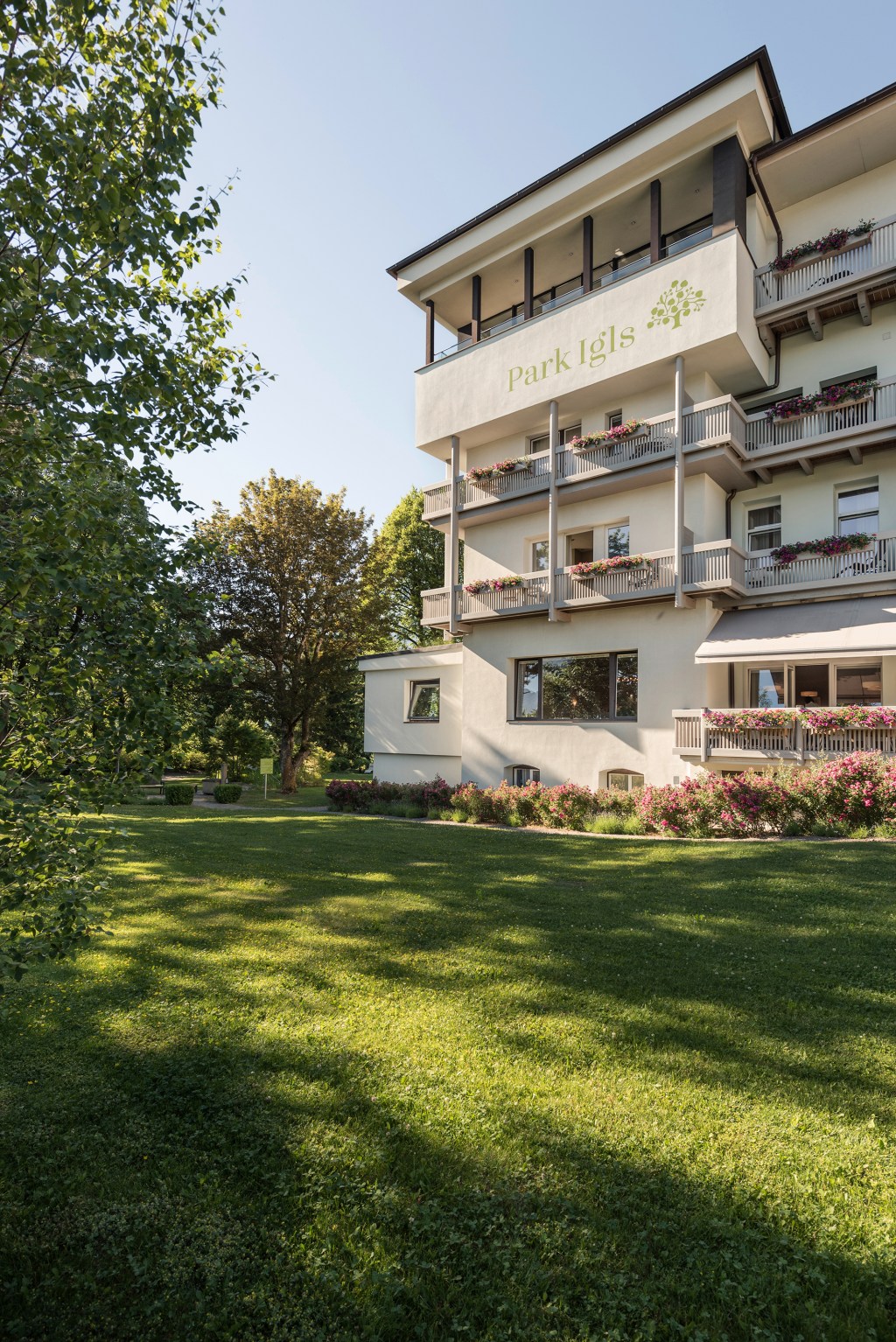
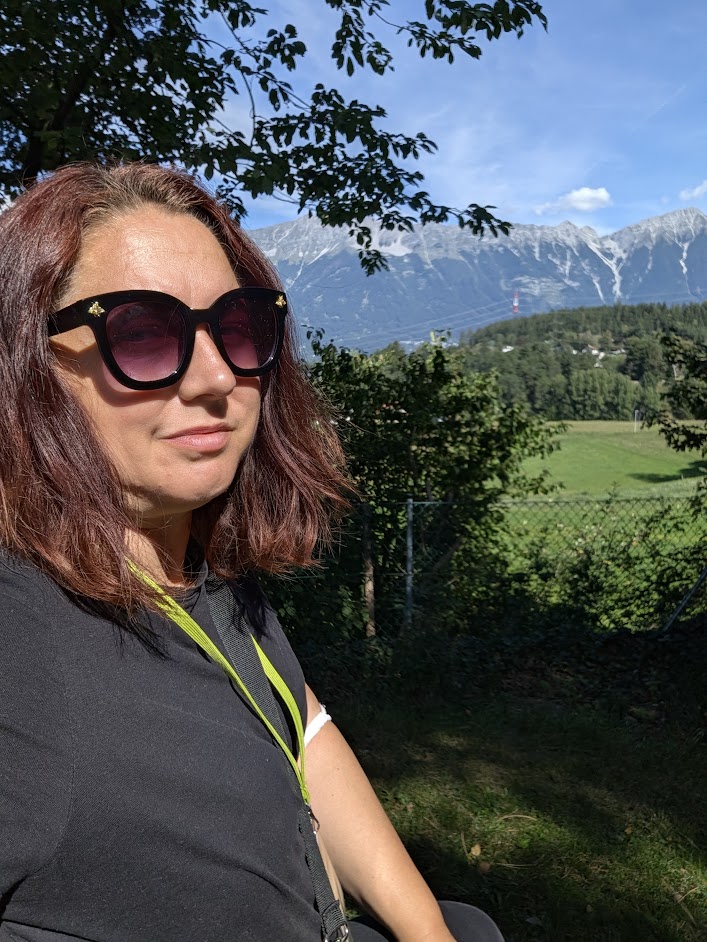
That was what brought me to Park Igls, a medical spa in the Austrian Alps where medical assessments, nutrition, exercise, treatments, relaxation and wellbeing are brought together within one environment. Set above Innsbruck, surrounded by mountains and sitting within its own green park, it felt immediately removed from the noise of ordinary life, even though the city itself was close by. The journey to Igls had already begun to change my perspective. As you travel through Innsbruck and begin to see the mountains rising around the city, the landscape has a way of putting everything into perspective. I had arrived from a world where my thoughts had been racing constantly, but Austria seemed to operate at a different speed. The mountains were enormous, the sky felt wider and there was something about being surrounded by nature that made it easier to breathe. Park Igls is close enough to Innsbruck that you can still enjoy the city and everything the destination offers, but once you arrive at the hotel, the feeling is much more like entering a retreat. I could be a traveller and a guest, but I could also simply disappear for a while and concentrate on myself.
I arrived without expecting a miracle. I knew that a few days in the mountains couldn’t erase years of emotional experiences or suddenly provide answers to every health concern. What I hoped for was something more realistic and, perhaps, more valuable: time and space to look at myself differently. Almost immediately, the setting seemed to provide exactly that. Innsbruck felt like a world away from the mental noise I had been living with. The mountains surrounded everything, the air felt clean and fresh, and there was a sense of openness that was difficult to describe unless you had experienced the contrast. For months, my thoughts had felt crowded and relentless. Suddenly, there was space everywhere I looked. Mountains outside the windows. Trees. Sky. Fresh air. Quiet. It felt as though my surroundings were asking me to slow down before I had even begun the programme.
Park Igls itself has a character that I found increasingly appealing as the days went on. It doesn’t feel like a clinical facility that happens to have comfortable bedrooms, nor does it feel like a conventional luxury hotel that has simply added a wellness menu. It occupies a space somewhere between the two.
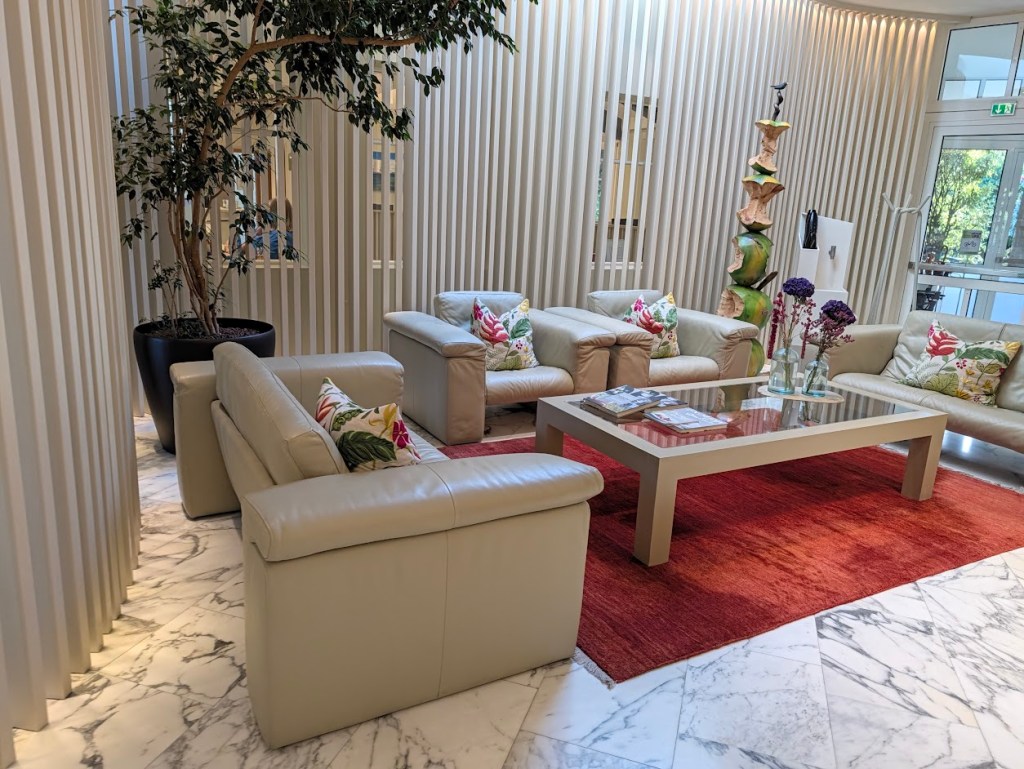
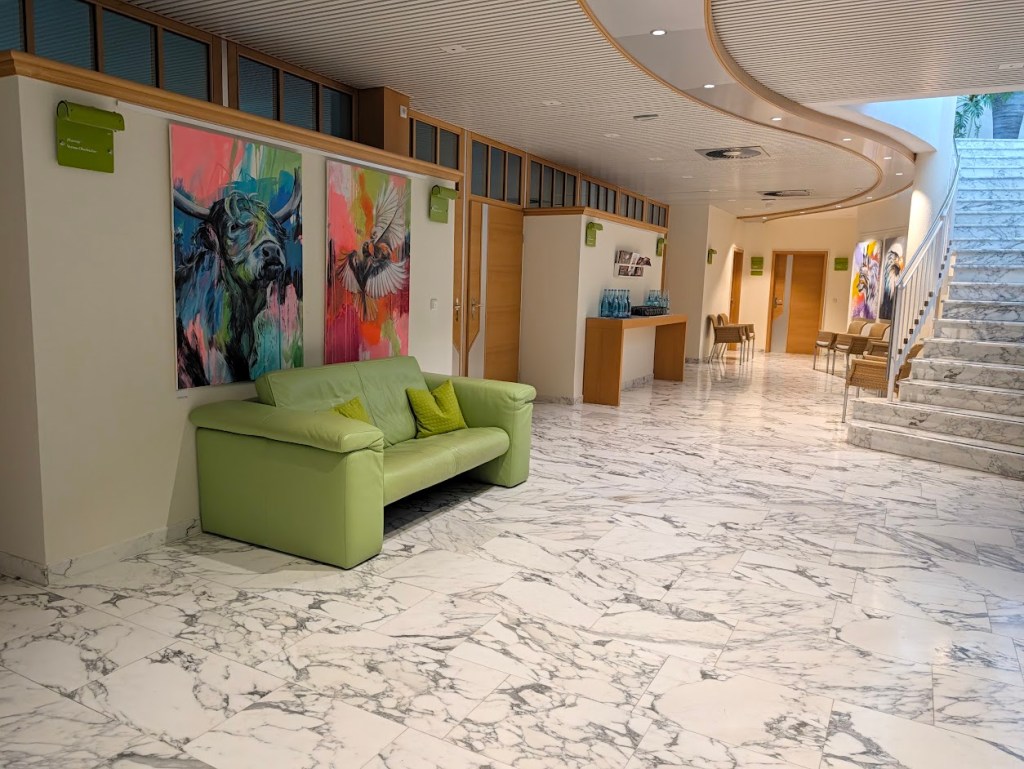
There is a serious medical element to the experience, after all it is a hospital where people seek treatment, but there’s also a spa element and a homely feel to it, like a hotel. When you check in you can’t help but notice the beautiful interiors, comfortable lounges, fine artwork by Christine Knoll, flowers, gardens, a restaurant, a swimming pool and the sense that you are staying somewhere designed to be lived in rather than simply passed through.
I found myself noticing the artwork around the hotel more and more as I slowed down. At home, I am often moving too quickly to really look at things. At Park Igls, I had time to notice the paintings, the decorative details, the textures and the way the interiors connected with the landscape outside. The art became part of the atmosphere rather than something I hurried past on the way to my next appointment.
And then there was the park itself. The gardens and surrounding greenery gave the hotel a feeling of openness that was particularly welcome because I had spent so much time feeling mentally enclosed. I could walk outside without having anywhere I needed to be. There were wildflowers, trees and quiet corners where I could sit. Sometimes I walked because it was part of my exercise programme; other times I walked simply because I wanted to feel the air and look at the mountains. That distinction became important. I was learning that not everything I did had to have a measurable purpose.
My room, 405, became my own little refuge within that refuge. At around 40 square metres, it was spacious without feeling impersonal, with panoramic windows that seemed designed to make the most of the extraordinary Tyrolean landscape. I had a private balcony, and there was a chair positioned in front of the mountains that quickly became my favourite place to sit and write. I would find myself looking out for long periods, sometimes with a notebook beside me and sometimes with nothing at all. There was a comfortable bed, a choice of pillows, plenty of wardrobe and storage space, a television with its guide and a spacious bathroom. Hot-water bottles and water were available outside the room, small touches that added to the feeling that everything had been thought about. It even had its own private sauna.
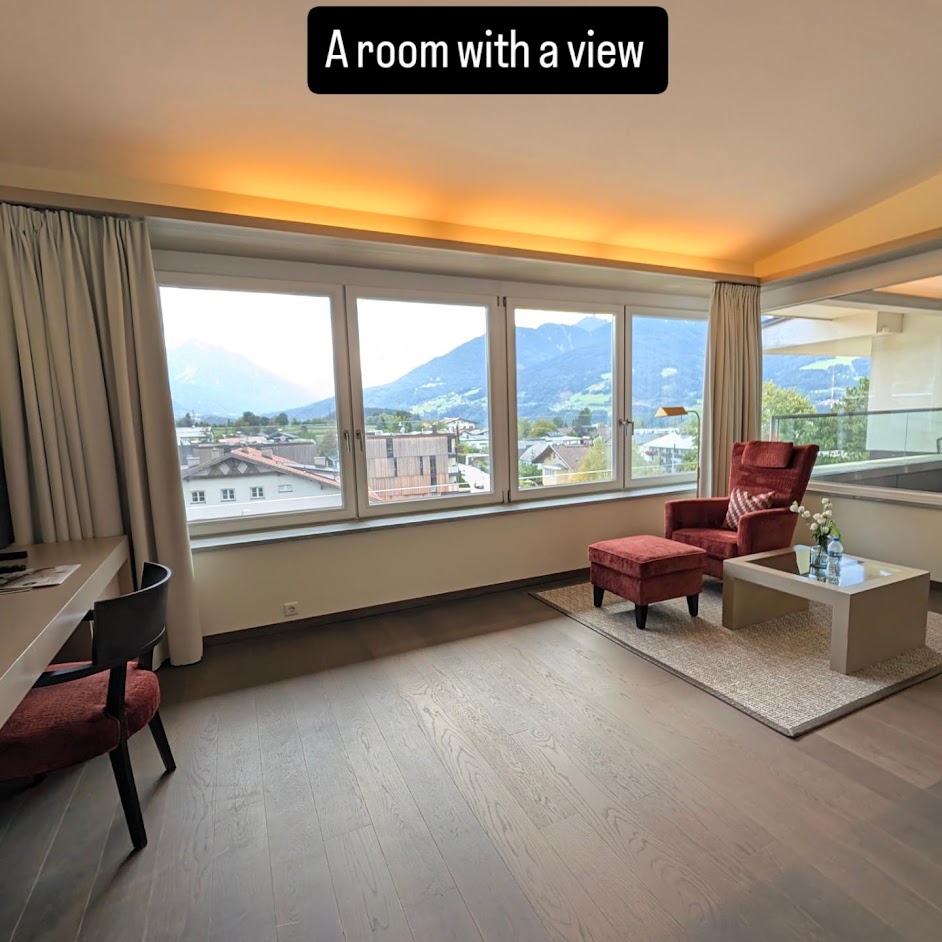
But it was the view that kept drawing me back. I could step outside onto the balcony and simply stand there, breathing in the mountain air, and remind myself of one sentence that gradually became something of a mantra: This is my time.
That sentence sounds simple, but when you have spent months feeling that you are constantly reacting to life, making decisions about your health, worrying about symptoms and trying to work out what happens next, giving yourself permission to stop can feel surprisingly difficult. Sitting in that chair with the mountains in front of me, I began to understand that perhaps the first thing I needed to do was not find another answer, but create enough quiet to actually hear myself.
The hotel made that possible in ways I hadn’t anticipated. I could move from a medical consultation to the restaurant, from an exercise session to the pool, from a treatment to a walk through the gardens. The heated indoor pool became one of my favourite places to unwind, while the sauna experiences, infrared cabin, steam room and quiet areas provided different ways of allowing my body to slow down. There was something wonderfully indulgent about being able to finish a treatment and then simply wander back towards the spa rather than having to get into a car, face traffic or return immediately to the demands of normal life.
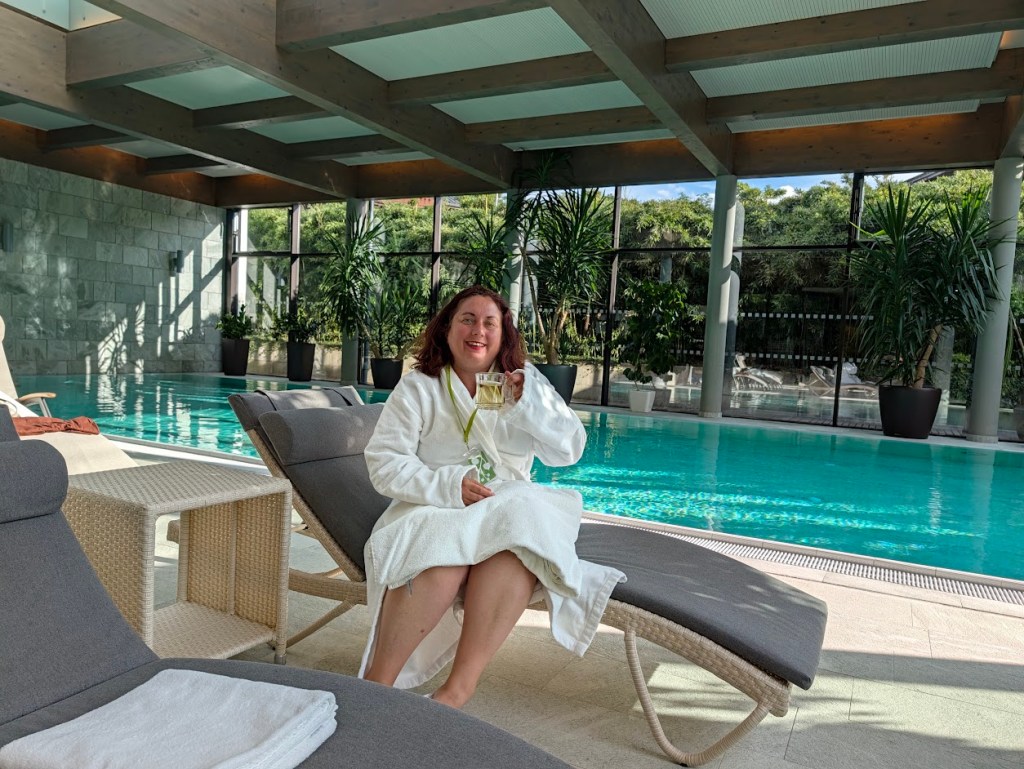
The whole property seemed to encourage a different rhythm. You could exercise in the morning, eat slowly, have a treatment, go for a walk, sit quietly, perhaps listen to music, read or simply stare out of a window. The days were structured, but they weren’t frantic. In some ways, that was one of the biggest luxuries of all.
Then I met the doctor Dr Gartner, and we spoke at length about how I was feeling and what I hoped to gain from my time at Park Igls.
I explained that one of my primary concerns was my low energy. I wanted to understand why I had been feeling so depleted and whether there might be an underlying cause. I was particularly concerned about my kidney function and hormone levels, and asked whether we could conduct blood tests to investigate these areas and provide some clarity.
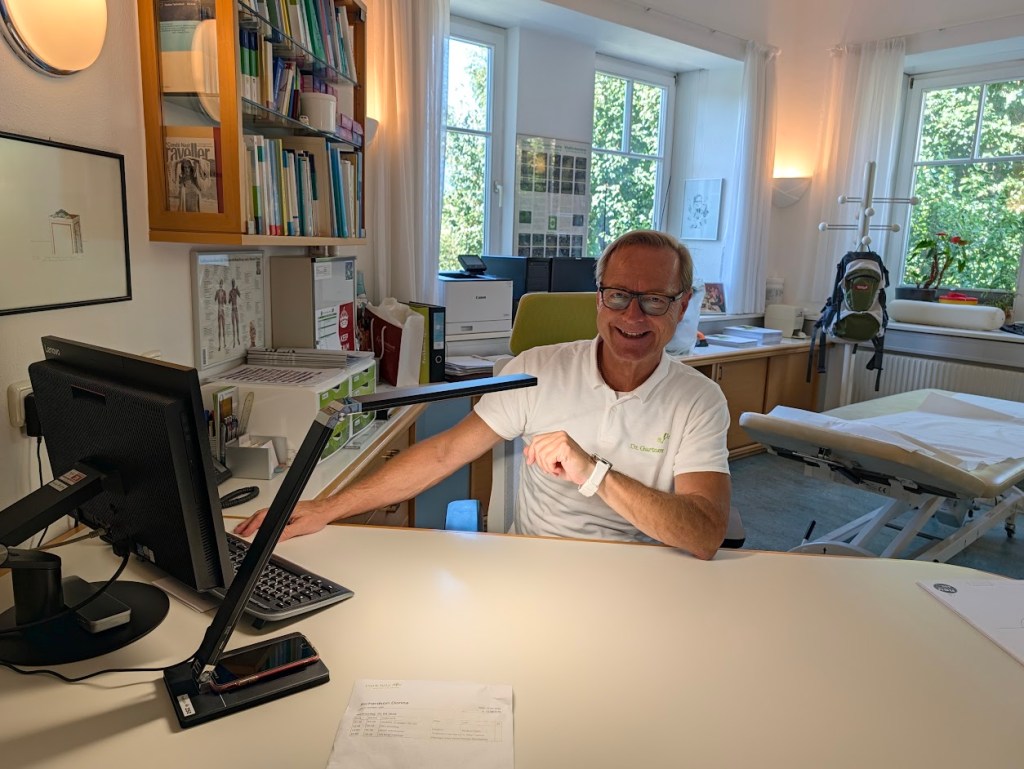
We also discussed my digestion. My bowel movements had become quite slow, and he felt that I was experiencing IBS, which he believed was partly related to stress.
Then he said something that stopped me in my tracks.
He pointed out that I had used the word “stress” twelve times during our conversation.
I had not realised I was repeating it so frequently.
We began discussing post-traumatic stress and the ways in which emotional experiences can continue to affect us physically. It was an uncomfortable conversation in some respects, but also an illuminating one. I had arrived focused on my kidneys, hormones, energy levels and digestion. Yet as we spoke, I began to recognise that these issues might not be entirely separate from what I had experienced.
My body had been carrying a great deal.
He explained the F.X. Mayr approach and how the programme was designed to give my digestive system a period of rest while supporting digestion and elimination. He also explained that weight loss could be part of the process.
I was interested in the idea that by slowing everything down—the way I ate, breathed and moved through the day—I might begin to give my body an opportunity to settle.
More than anything, I wanted answers.
Why was I so tired? Why did I feel as though my body was not functioning as it should? And to what extent might what I was experiencing be connected to the prolonged stress I had been carrying?
The blood tests would hopefully provide some of those answers.
For the time being, however, I was beginning the Mayr programme: slowing down my eating, paying closer attention to digestion, receiving treatments and, perhaps most importantly, learning to listen to my body again.
After everything I had been through, this felt like a very different approach to my health.
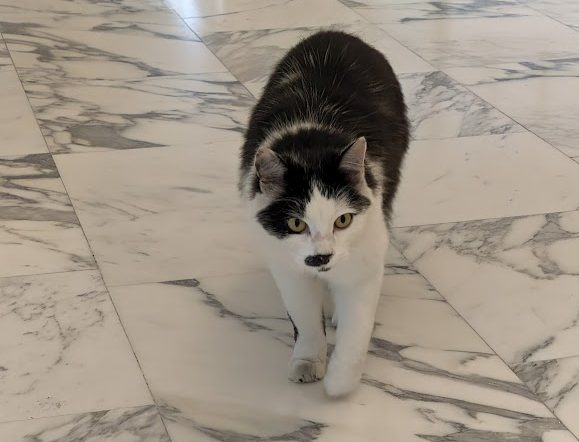
The nurse did my bloods and my urine analysis and made me feel at home. All the staff here are friendly and there was even Loki, the resident cat, who seemed to understand that not everything needed to be taken quite so seriously. Loki greeted me during my stay and quickly became another small but memorable part of the experience. Park Igls even has pet therapy, and I found something incredibly comforting about the simple presence of an animal in a place where so much attention is focused on health. After months of emotional overwhelm, stopping to stroke a cat or watch him wander around the hotel might seem like a tiny thing, but tiny things were beginning to matter to me. Comfort didn’t always have to come in the form of a major breakthrough. Sometimes it came with four paws and a purr.
The first thing I began to understand was that the programme was not really about one treatment or one diagnosis. It was about looking at different parts of life at the same time. There were medical consultations, blood and urine tests, conversations about my health, nutrition, movement, sleep and emotional wellbeing. Park Igls works with a broad range of health concerns and conditions, including digestive and metabolic issues, neurological conditions, autoimmune concerns and rehabilitation, alongside the wider areas of preventative and lifestyle medicine. That breadth was important to me because I had arrived wanting a single explanation for everything I was feeling. Instead, I was encouraged to consider the possibility that health is rarely that simple. Sleep, digestion, movement, nutrition, stress and emotional wellbeing can all form part of the wider picture, while proper medical investigation remains essential when symptoms need further assessment.
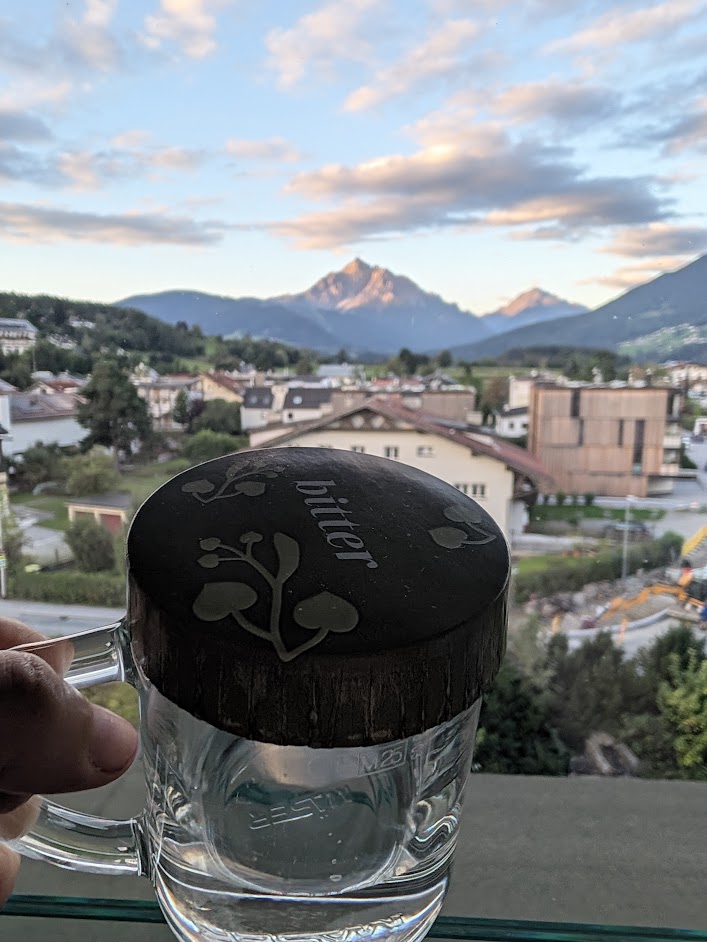
The centre’s philosophy is rooted in the principles of Modern Mayr Medicine, which builds on the traditional FX Mayr approach. The original principles focus on Rest, Cleansing, Education and Substitution, while the modern approach also places emphasis on Exercise and Mindfulness. What interested me was that these weren’t presented as isolated ideas. They became part of the rhythm of everyday life. Rest was not simply lying down when I was exhausted. Education was learning to chew properly and to pay attention to how I ate. Exercise was not about punishing my body. Mindfulness could mean counselling, talking, mental training or simply becoming more aware of what was happening inside me.
The traditional Mayr approach also includes practices such as careful chewing, plenty of fluids and, within the programme’s philosophy, elements such as bitter waters, Epsom salts and nutritional supplementation. I came to understand that these were part of a particular medical and dietary tradition rather than universal medical rules, and that some of the language around cleansing and detoxification needs to be treated carefully. What was most useful for me was not the idea that there was some magical process that could cleanse away everything that was wrong with me, but the discipline of slowing down, paying attention and changing habits that had become automatic.
I also had a counselling assessment, and that was perhaps one of the most difficult parts of the experience. The conversations helped identify PTSD connected to childhood abuse. Having those experiences acknowledged was painful, but there was also something strangely liberating about hearing what I had carried for so long recognised for what it was. I did not suddenly resolve my childhood in a counselling session, and Park Igls could not erase those experiences. But I began to understand that the mind and body I had been trying so hard to keep functioning were carrying a much heavier load than I had allowed myself to admit.
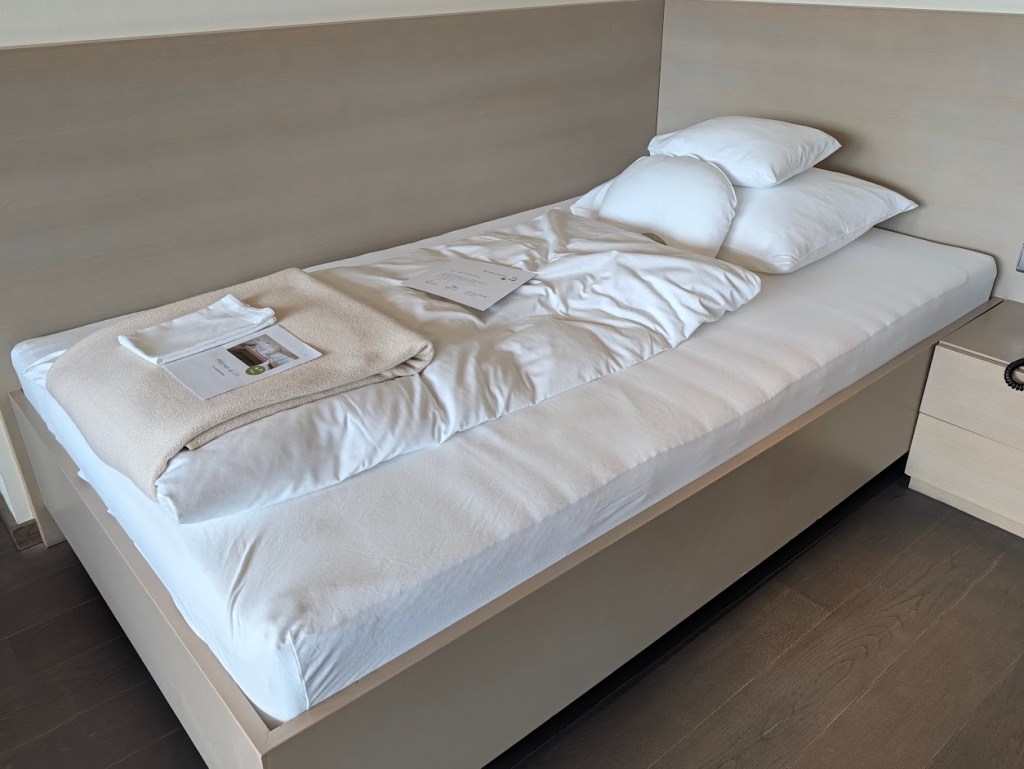
Then there was sleep. On my first night I slept for more than twelve hours, something that shocked me. I had become so accustomed to feeling tired that I had almost forgotten what genuine rest could feel like. By Day Four, I was sleeping around ten hours a night. A lecture called “Sweet Sleep” with Dr Melanie Robertson helped me think about rest differently. I had spent so much time feeling that I should be doing something — researching, exercising, solving, achieving — that simply sleeping could feel unproductive. Here, rest became part of the programme rather than something squeezed into whatever time was left over.
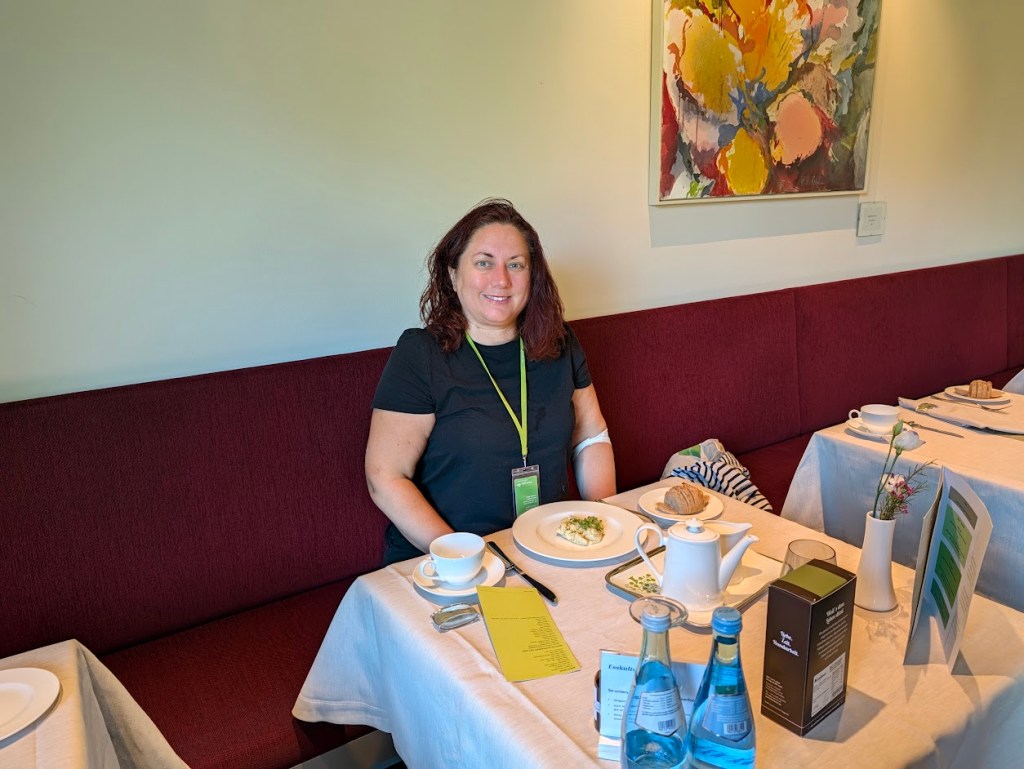
Food was another area where I had arrived with expectations and assumptions. I had always associated programmes like this with the idea of fasting and imagined that fasting meant simply not eating. The reality was much more nuanced. Park Igls has eight dietary stages, and only very few cases involve the lowest level of tea fasting. The programme can move through different stages according to individual needs, and I began at the more restrictive end before gradually progressing. I started with level three Mayr foods plus soups, protein and broths, and later had a greater variety and more substantial meals. Full meals were reintroduced after Day Four, and the progression felt much more manageable than I had imagined.
I arrived to vegetable strudel before moving on to the Stage Three diet, and even the bread came with its own lesson: this was not food to be swallowed quickly, but something to be chewed slowly and thoroughly and create a saliva in the mouth. That may sound obvious, but it was surprisingly difficult to change a habit that had become so unconscious. I was used to eating while thinking about the next thing, chatting, working or simply rushing. Here, eating became something that deserved my full attention.
Breakfast became an education in itself. There was sheep’s milk yoghurt, low-fat yoghurt and acidophilus curdled milk, alongside malt coffee and milk – one of my favourites — as well as soya and cow’s milk. Depending on the stage and individual plan, there were protein-rich choices including boiled or scrambled eggs, beetroot hummus, Tyrolean Alpine cheese, sliced turkey and salmon. There were beautifully made soups, goat’s cheese mousse and other carefully prepared dishes, and later I enjoyed substantial meals including sea bass. Everything was presented with care, and even the more traditional Mayr foods felt considered rather than austere.
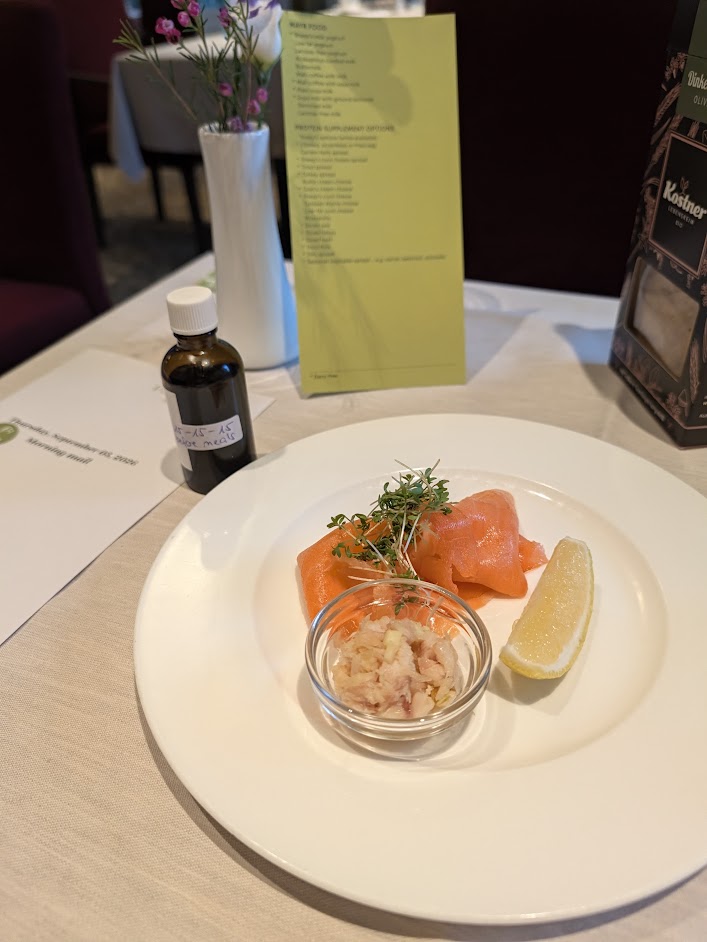
The food itself was a revelation. The restaurant was, in my opinion, second to none, and the chef really ought to have at least one Michelin star. Everything was beautifully presented but never felt like food designed simply to look impressive. I had expected restrictive health-retreat food and instead found myself eating meals that felt remarkably close to fine dining. There was pleasure in the food, and that mattered because I had arrived with enough anxiety around my health without adding a fear of eating.
More importantly, I began to notice the experience of eating itself. I learned to slow down, chew properly, notice texture and flavour and, importantly, notice how I felt afterwards. Food slowly became less of something I worried about and more of something I could experience.
Food, and learning to eat again
The food itself was a revelation.
In my opinion, the restaurant was second to none, and the chef really ought to have at least one Michelin star. Everything was beautifully presented, but never felt like food designed simply to look impressive. I had arrived expecting restrictive health-retreat food and instead found myself eating meals that felt remarkably close to fine dining. There was genuine pleasure in the food, and that mattered. I had arrived with enough anxiety around my health without adding a fear of eating.
On my very first day at Park Igls, I was served a delicious soup and vegetable strudel. It felt like a gentle introduction to what was going to become a very different relationship with food.
I then began the Mayr No. 3 diet, and one of the first things I was taught was something that sounds incredibly simple but actually made me stop and think: chew your bread properly and allow it to mix with saliva before swallowing. The idea was to slow everything down and pay attention to that first stage of digestion rather than simply eating without thinking.
From there, I moved through the Mayr diet, which involved a choice of milk-based Mayr food in the morning, followed by a choice of protein. I typically chose eggs or salmon. In the evening, I would often have turkey, goat’s cheese and other carefully selected foods, with the option of a vegetable-based broth between meals.
Everything felt measured and intentional. It wasn’t simply about what was on the plate; it was about how I was eating it.
As I progressed to Stage Four, I was able to return to food-combining meals, and that felt like another little milestone. My first meal was a delicious sea bass with bell peppers, and I remember being struck by how much I was actually tasting. I wasn’t rushing. I was chewing, savouring and noticing the flavours and textures.
It sounds like such a basic thing, but when you have spent a long time eating on autopilot, genuinely experiencing your food can feel surprisingly profound.
The soups have been wonderful too. Tomato, parsley and even pear soup — each one completely different, each one making me realise that healthy food doesn’t have to mean deprivation. There is an extraordinary amount of flavour and creativity in what is being served here.
But day five’s meal deserves a special mention. Guinea fowl with pea jus was simply superb. Honestly, these guys should get a Michelin star. I never expected one of the highlights of a health retreat to be the food itself, but some of the meals have genuinely been restaurant quality. It has completely challenged my idea that eating for your health has to mean sacrificing flavour, pleasure or enjoyment.
Perhaps what I am appreciating most is that I am actually tasting the food.
I’m learning to slow down, put my cutlery down, chew properly, savour each mouthful and give myself time. The difference is extraordinary. Instead of simply eating because it is mealtime, I am becoming much more aware of what I am eating, how I am eating it and, importantly, how I feel afterwards.
The Mayr programme has also made me think much more about the relationship between digestion, the gut and the brain. I’ve been learning to be present rather than rushing through meals, as I have often done in the past. I’m only five days into this journey, so I certainly haven’t mastered it, but I can already feel that something is changing in the way I approach food.
Food has become a much bigger part of my experience at Park Igls than I ever expected. More than that, it has become part of the wider idea of healing for me.
Not because I suddenly believe there is one perfect diet that can solve every problem, but because I’ve begun to appreciate just how fundamental food is to our everyday health. We eat every day, often without thinking about it, and the quality, quantity and way we eat can all become part of the bigger picture of how we feel.
Perhaps that is one of the biggest lessons of Park Igls so far: food isn’t simply fuel. It can also be an opportunity to pause, to be present and to listen to what my body is telling me.
After months of stress and uncertainty, learning to sit down and genuinely savour a meal has become another part of learning how to slow my life down.
And perhaps, in the end, that is what has surprised me most. I came here expecting to change what I eat. I didn’t expect to change the way I eat.
Toxins
There is a constant modern conversation around “toxins” and detoxification, and I became more cautious about simplistic claims that a particular food, treatment or fasting programme can somehow cleanse the body of every problem. We cannot simply detox our way out of illness. But we can make choices that reduce some of the unnecessary burdens of a highly processed lifestyle and give our bodies nourishing food, hydration, rest and better habits. For me, that felt less like a dramatic detox and more like a decision to give myself a healthier chance at life.
That lesson continued in sessions such as “The Gut, the Brain and Peace”, where the connection between physical and emotional wellbeing became another thread running through my stay. There was no magical solution offered, and I appreciated that. Instead, there was a growing sense that perhaps I did not have to separate everything into neat boxes labelled digestion, stress, sleep, emotions or exercise. They were all parts of the same person — me.
I began to think about my relationship with food. I am fascinated by the gut-brain axis and the ways in which the gut, nervous system and immune system interact. There is increasing scientific interest in possible links between the gut and neurological and autoimmune conditions, although these are complex areas and an association does not automatically mean that one thing causes another. For me, the conversation was less about finding another theory to worry about and more about understanding that the body is interconnected.
Moving your body
Movement became an equally important part of that realisation. Before those difficult six months, I had genuinely enjoyed going to the gym. I liked being active, challenging myself and feeling strong. But as stress, trauma and emotional exhaustion took over, exercise gradually became another obligation. The motivation disappeared. Even things I had once enjoyed started to feel like work.
At Park Igls, I was reminded that movement did not have to mean punishing myself or forcing my body through a workout when I had nothing left to give. There were morning workouts and mobilisation sessions, alongside a surprisingly varied programme of classes throughout the day.
I tried Aquafit, knee stabilisation, fascia training and massage, trampoline movements and stability-ball training. There were targeted sessions for my hips and knees, work for my shoulders and upper body, stretching and mobilisation, and opportunities for more traditional gym training too. One of the things I particularly enjoyed was the sense that each class had a purpose. Rather than simply being told to exercise more, I was encouraged to understand my body and how it moved.
Miriam, an ex-Olympic luge athlete, helped me rediscover some of the confidence I had lost in movement. Personal training sessions challenged me without making me feel that I had to prove anything. I also tried four HIIT exercises, explored the gym, worked on strength and mobility and went Nordic walking in the mountains. At other times I simply went to the pool and floated.
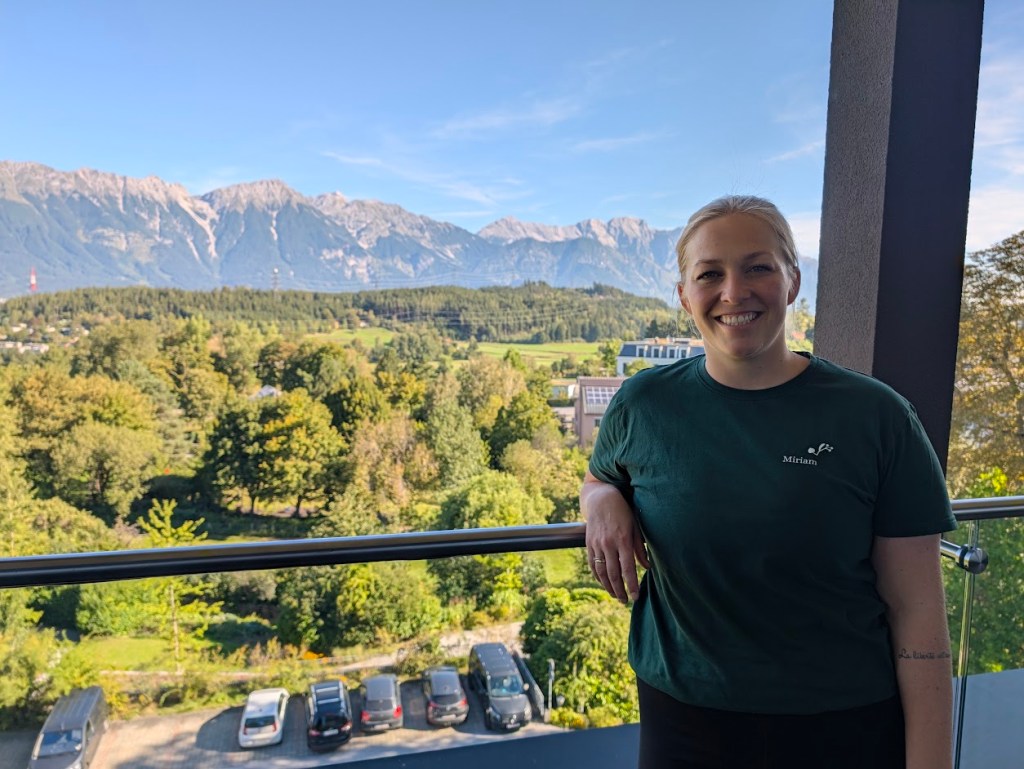
There were so many ways to move that I stopped thinking of exercise as a single category. I began to see it as a huge menu of possibilities: weights, resistance bands, bodyweight work, Pilates, functional training, walking, swimming, rowing, cycling, dancing, HIIT, yoga, stretching, mobility work, hiking, Nordic walking, skiing and group classes.
There is no single correct way to exercise. The right movement is the movement that works for you, your interests, your fitness level, your health needs and your life. And sometimes the motivation comes after you begin moving rather than before.
That was certainly true for me.
Somewhere between the morning mobilisation, the classes, the personal training, the Nordic walking and the time spent outdoors, something started to shift. I stopped thinking of exercise as something I had failed at and started experiencing it as something that could give something back to me.
I felt strong. I felt alive.
The talks were part of that process too. A health talk on motivation and drive with Gerald Autengruber made me think about what actually motivates us to take care of ourselves, particularly when we have been through periods when even getting through the day can feel like enough. I began to think less about dramatic reinvention and more about momentum. Perhaps looking after your health is not about waking up one morning transformed into a completely different person. Perhaps it is about making one small decision, then another, until those decisions begin to create a different direction.
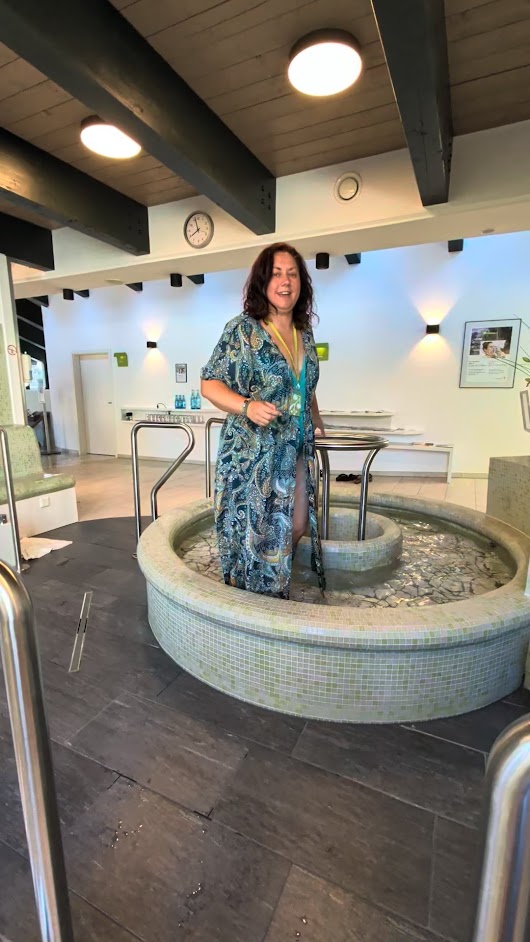
Kneippen was also part of the daily rhythm at Park Igls, used to stimulate circulation through alternating warm and cold water. At first, the cold water was something I had to mentally prepare myself for, and my instinct was still very much, “Get me out of here.” But as the days went on, I became more familiar with the sensation and began to approach it differently. Instead of resisting the cold, I tried to breathe through it and stay present. There was something almost meditative about learning to accept that brief discomfort and waiting for the warmth to return. What had initially felt like something I simply had to endure became another small lesson in resilience and in paying attention to how my body responded.
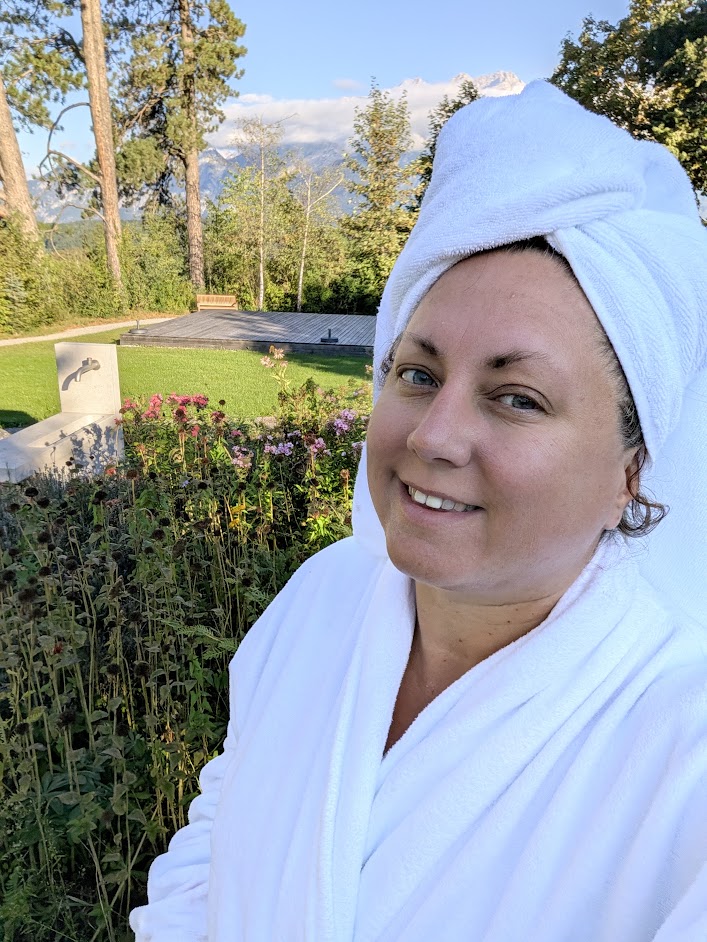
The treatments added another dimension to that feeling of being cared for. There were massages and full-body massages, and I found myself looking forward to the simple luxury of lying down and allowing somebody else to take care of me. I had reflexology with Veola, which was another opportunity to simply be still. There were wraps, warmth and treatments that created that cocooned feeling of being temporarily removed from the demands of ordinary life.
One of the most memorable experiences was the hayflower ceremony, a traditional Austrian treatment described to me as something handed down through generations of Austrian women. There was something deeply evocative about experiencing a tradition so connected to the landscape around me. The warmth, the scent and the ritual made it feel like much more than simply another treatment on a timetable. It felt connected to place and tradition, and I found myself thinking about how different this experience was from the frantic way I had been trying to manage my health at home.
I also experienced heat compresses as part of the programme. They were described within the traditional approach in terms of cleansing the body, but I found that what I personally responded to most was the warmth and stillness. I enjoyed the feeling of being wrapped up and cared for, of not having to do anything for a while. I wouldn’t claim that a compress medically detoxified or cleansed my body. What it gave me was an experience of warmth, relaxation and quiet, and sometimes that alone felt valuable.
Day Three was a reminder that recovery is not always a straight line. My digestion was still unpredictable, with my bowel movements changing from one day to the next, and I was becoming very aware of just how much my gut could affect how I felt physically and emotionally. After months of worrying about my digestion, it was difficult not to notice every change. But instead of seeing an unsettled day as a failure, I was beginning to understand that the body does not always follow a neat schedule simply because we want it to.
I had another warm compress, followed by personal training and lymphatic drainage. I walked among the wildflowers, listened to a jazz pianist and later returned to my room, had a bath and used my own sauna. Nothing dramatic happened. There was no sudden moment when everything became clear. But perhaps that was the point. Self-care does not have to mean that every day is perfect. Sometimes it means accepting that things are unpredictable and still choosing to look after yourself.
The lymphatic drainage treatment with Josef was another experience that made me more aware of my physical body. Afterwards, my legs felt lighter, and I became more conscious of how much physical heaviness I had been carrying. Work around my abdomen and diaphragm also drew my attention to my breathing. I realised how often I was holding my breath or breathing shallowly without even noticing. The feeling of release was very real to me, even though I understood that a subjective sense of release is not proof that my organs had somehow been “cleansed”. It was another reminder that paying attention to the body can reveal things that become invisible when we spend all our time living inside our heads.
Kickboxing
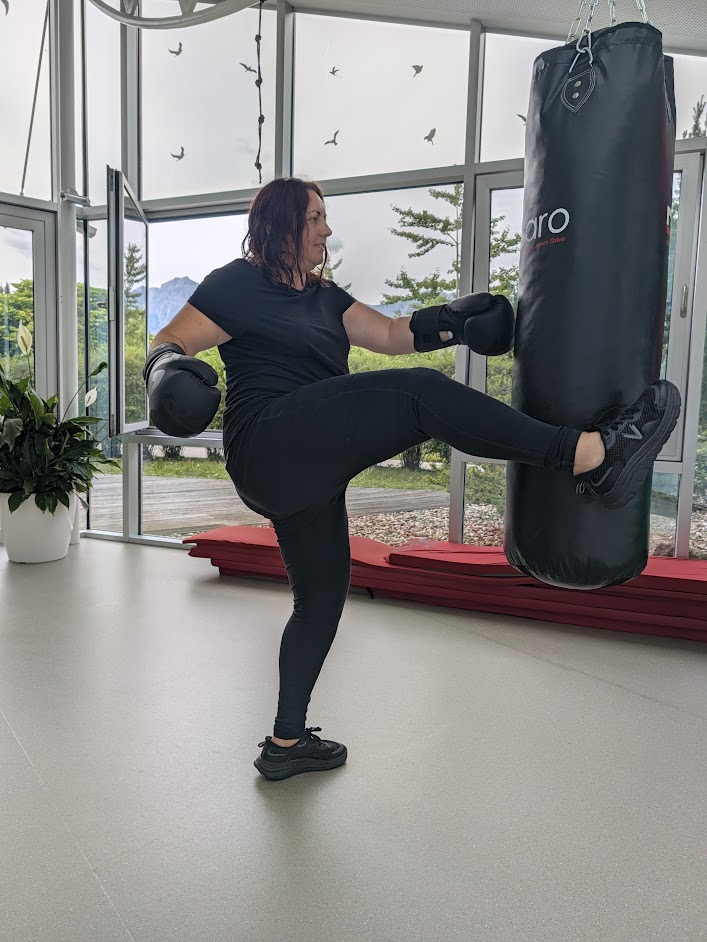
And then there was kickboxing. It was not something I had expected to find at a medical spa, but it became an unexpectedly satisfying outlet for all the tension and anger I had been carrying. I was taught by a national Kickboxing champion Julia Kovaks, She taught me some techniques and then all I had to do was
Punch
Kick
Breathe.
Release.
I loved it and think I have a new hobby when I come home.
For a short while, there was no analysing anything. I could simply move.
By Day Four, I felt as though something had begun to shift. Loki, the resident cat, greeted me that morning, and I was reminded that there was even pet therapy at Park Igls – another gentle way of bringing comfort, connection and a little joy into the experience. His presence was such a simple thing, but after months of feeling emotionally overwhelmed, those small moments of warmth mattered. I looked more rested. I looked brighter. More importantly, I looked a little more like myself.
That day also brought the hayflower ceremony, on a water bed. There was something deeply evocative about experiencing a traditional Austrian treatment so connected to the landscape around me. Surrounded by the warmth, scent and ritual of the treatment, I found myself thinking about how different this experience was from the frantic way I had been trying to manage my health at home.
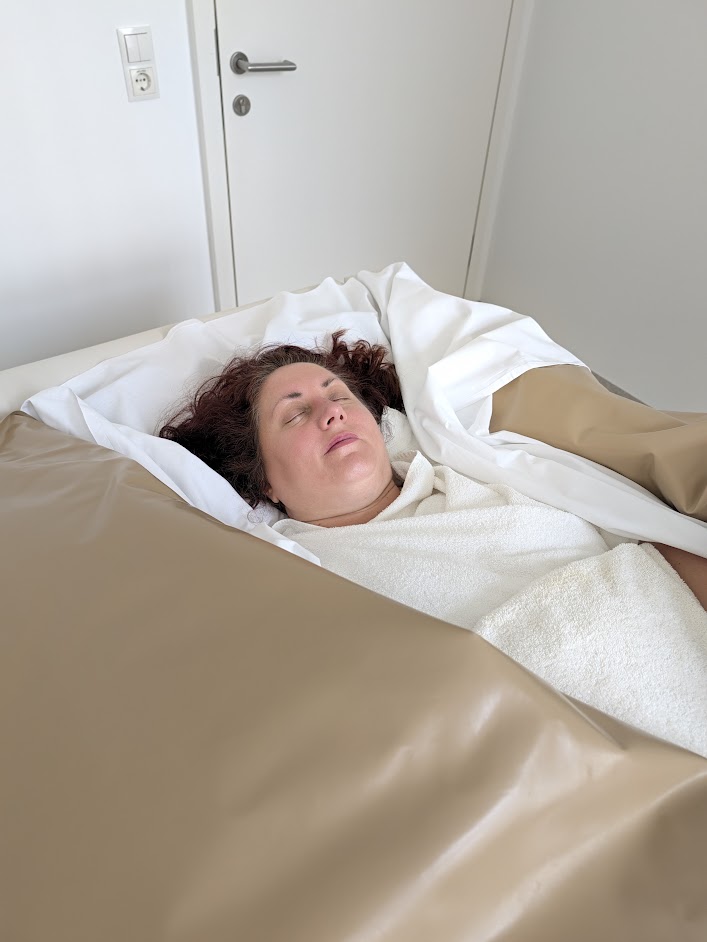
I wasn’t cured. My problems had not disappeared. But I felt better, and after the months I had been through, that was significant. It was enough to make me realise that feeling better did not have to mean having every answer.
By Day Five, the rhythm of Park Igls was beginning to feel almost natural. I had settled into the combination of morning movement, mobilisation, treatments, nourishing food and periods of genuine rest, I had a Craniosacral therapy (CST) is a gentle, hands-on massaging technique. It uses a light touch to release tension around your body’s connective tissue network called the fascia. and I was becoming more comfortable with allowing myself to be cared for. I also had another massage with Verena, whose magical touch had made an impression on me from the moment I first arrived. There was something about the way she worked that felt instinctive and deeply attentive. Her treatment seemed to create movement not only physically, but emotionally too, as though the body was responding to something I had been holding on to without fully realising it.
Alongside the massage and reflexology, I became increasingly aware of sensations, tension and emotions that I had perhaps been too busy or overwhelmed to notice before. I didn’t see it as some miraculous unlocking of years of pain, but there was a powerful feeling of release in being able to stop, breathe and allow myself to feel what was there.
This was also the day I had my liver compress, another traditional element of the programme. Lying there in the warmth, I found myself appreciating how simple some of these treatments could be. There was no need to talk, analyse or achieve anything. I could simply lie still, feel the warmth and let myself rest. I had arrived at Park Igls with such a strong desire to understand what was happening inside my body that it was strangely comforting to experience something that asked nothing of me except to slow down. I wouldn’t claim that the compress medically “cleansed” my liver or body, but as an experience it gave me warmth, stillness and another opportunity to listen to what my body was telling me.
By Day six, movement had become one of the clearest threads running through my stay. There was a movement lecture that gave me another opportunity to think about the way I use my body, not simply in terms of exercise or fitness, but in terms of everyday movement, posture, mobility and awareness. By then I had already experienced Aquafit, knee stabilisation, fascia training and massage, trampoline movements, stability-ball exercises, morning workouts and mobilisation, as well as personal training and Nordic walking. What had surprised me was how different each session felt, and how each one seemed to teach me something slightly different about what my body could do.
There was another full-body massage with Josef too, and by this point I had stopped thinking of treatments as something I had to rush through between other activities. The massage became another pause in the day, another chance to be still. After everything I had experienced — the movement, the treatments, the conversations, the food, the rest and the emotional work — I was beginning to appreciate that recovery could contain both activity and stillness. I didn’t need to choose between pushing myself and doing nothing. There was a middle ground where I could move, strengthen, breathe, rest and simply be cared for.
And then, on the final day, came the final examination with Dr Gartner. After a week of being encouraged to slow down, eat differently, move in different ways, rest properly and pay attention to what my body was telling me, it felt important to finish where I had started — with a medical assessment. I had arrived at Park Igls desperate for answers, wanting someone to explain why I had been feeling the way I had been feeling. Now, sitting with Dr Gartner at the end of the programme, I realised that the week had given me something slightly different from the definitive answer I had originally been looking for.
It had given me a clearer picture of myself, a better understanding of the things that could influence how I felt and, perhaps most importantly, a renewed willingness to listen. The final examination was a chance to reflect on the changes I had experienced during my stay and to consider what I could take forward with me into everyday life. I was leaving with questions still to explore and with the understanding that proper medical follow-up remained important, but I was no longer approaching my health solely from a place of fear. I felt more informed, more aware and, for the first time in a long while, more hopeful.
Looking back, the rhythm of the days may have been one of the most valuable parts of the entire experience. There was exercise in the morning, perhaps a treatment later, time to eat slowly, time to walk, time to sit quietly and time to sleep. I could be active without exhausting myself and rest without feeling guilty. I could walk through the park without needing to reach a particular number of steps. I could sit on my balcony and stare at the mountains without needing to achieve anything at all. The instruction I kept coming back to was not “do more”. It was pay attention.
And the mountains made that easier. Walking among the Alps and the wildflowers gave me perspective. Nature does not solve your problems. It does not erase trauma, fix digestion or answer questions about your health. But it can create space around those problems. When I looked up at the mountains, the things that had felt enormous inside my own head seemed, for a moment, to occupy a different place.
Travel itself had become part of the healing experience. I had arrived in Austria thinking of the trip primarily as a health intervention, but gradually I realised that being somewhere beautiful was doing something too. I was seeing a different landscape, hearing different sounds, experiencing Austrian traditions and stepping away from the familiar routines in which my anxiety had taken root. Innsbruck gave me the best of both worlds: the energy and culture of a city surrounded by extraordinary mountains, with Park Igls providing somewhere peaceful to retreat to afterwards.
I didn’t need to spend every day sightseeing. In fact, that would have defeated the purpose of the trip. Instead, I began to travel more slowly. A walk among the wildflowers became an experience. Looking at the mountains from my balcony became an experience. Sitting by the pool became an experience. Listening to a jazz pianist became an experience. Eating a beautifully prepared meal slowly became an experience.
I was learning that travel doesn’t always have to be about how much you can fit into a day.
Sometimes it can be about how much you actually notice.
That was perhaps the biggest change I took away from Park Igls. I arrived wanting answers. I left without every answer, but I was listening to my body again. I had remembered what it felt like to sleep properly. I had remembered how good movement could feel when it was not punishment. I had learned to slow down when I ate. I had discovered that breathing could change when I actually paid attention to it. I had allowed myself to talk about things I had avoided for years. I had spent time outside. I had rested. I had been looked after.
And slowly, I began to understand that perhaps I had been trying to control too much.
I cannot control every symptom. I cannot rewrite my childhood. I cannot guarantee what will happen to my health in the future. I cannot remove uncertainty from life, no matter how many questions I ask or how much research I do. But I can sleep. I can breathe. I can move. I can eat slowly. I can ask for help. I can talk about difficult things. I can rest. I can pay attention. I can notice when something is not right and seek proper medical advice rather than simply trying to push through it.
Perhaps I needed to stop.
When I think back to the person who arrived in Innsbruck, I remember how much I felt that my health was happening to me. Symptoms appeared, anxiety followed, questions multiplied and I reacted to each new sensation as though I needed to solve it immediately. When I left Park Igls, I did not suddenly have complete control over my health. But I felt that I had regained a small sense of ownership. Not because the spa had magically fixed me, but because the time, support and structure had helped me see my body differently.
It was no longer simply the source of symptoms I was frightened of.
It was something I needed to care for.
Leaving was emotional because, of course, real life was waiting. There would still be appointments, questions and uncertainty. There would still be difficult days. I would have to work out how to bring what I had learned back into ordinary life. Could I protect my sleep? Could I keep moving without turning exercise into punishment? Could I eat more slowly? Could I recognise when stress was beginning to build? Could I ask for help before reaching breaking point? Could I allow myself to rest?
I wanted to take these observations with me to my NHS appointments too — not as a replacement for medical care or proper investigation, but as a starting point for more informed conversations about what I had experienced and what support I might need going forward.
That, ultimately, is what Park Igls gave me.
Not a miracle.
Not a cure.
Not a dramatic transformation in which every problem disappeared against the backdrop of the Alps.
It gave me a beginning.
A beginning in which I could imagine taking better care of myself without feeling that I had to fix everything at once. A beginning in which health was not simply about chasing symptoms, but also about sleep, food, movement, emotional wellbeing, rest, connection and knowing when to ask for help. A beginning in which I could stop fighting my body long enough to listen to it.
For six months, I had felt as though I was losing control.
In Austria, I started to take some of it back.
Maybe healing is not one big decision. Maybe it is a series of small ones: going to bed, taking a walk, eating slowly, breathing deeply, speaking honestly, resting when you need to, moving because it feels good rather than because you think you should. Maybe it is accepting that some questions will remain unanswered for a while and choosing to live gently alongside that uncertainty.
I came to the mountains looking for answers.
I left with something different.
I left with the feeling that I could begin again.
You are still here. You can begin again. You don’t have to fix everything today. Just keep listening.
 LUXE Serendipity magazine
Leave a comment